
AI wrote the listing. It’s still your ad.
Paste any listing draft and see every Fair Housing red flag and unconfirmed claim before it goes live, with the reason, the source, and a safer rewrite.
Not legal advice. A word and fact check, not a compliance sign-off.
General notes
- 124 written rules. 106 that flag a phrase, and 18 that explain acceptable terms, like "master bedroom". Each cites a source: the Fair Housing Act, 24 CFR 100.75, HUD's 1995 memo, and the LIBOR, CRMLS and NYPA lists.
- Rule-based, no AI model. It can't invent a claim about the property. Rewrites change wording, never facts.
- Runs in your browser. The text is never uploaded, and there's no account or daily limit. The checker is free, and Pro is $29 once.
AI's favorite phrases are on the caution lists.
75% of Realtors who use AI use it to write listing descriptions (NAR 2026 Realtors Technology Report, via HousingWire). The drafts come back in seconds, and they lean on lines like these.
A fluent draft isn't a reviewed one. Whoever places the ad answers for it.
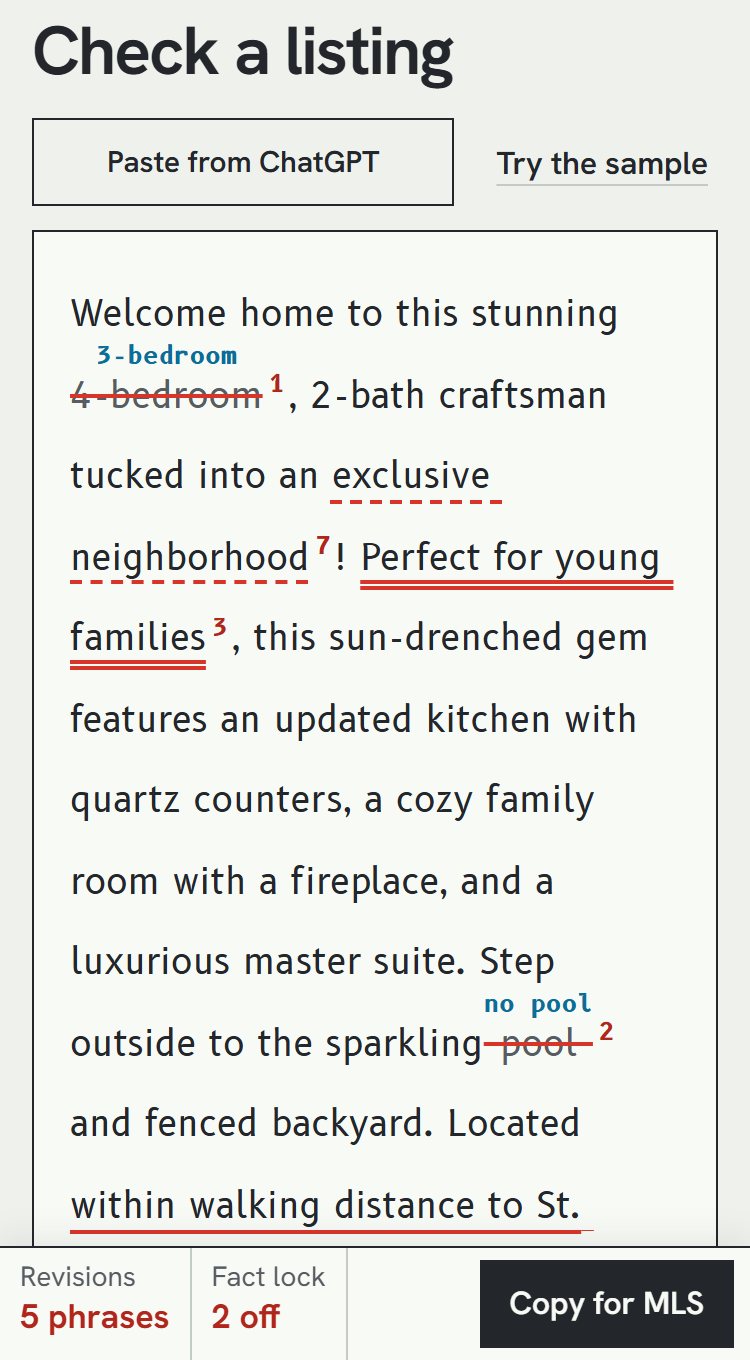
Perfect for young families
High Familial statusSays the home is for one kind of household, and implies an age. HUD's 1995 memo bars stating a familial-status preference.
ideal for empty nesters
High Familial statusPrefers households without children at home. On the avoid side of all three cited word lists.
walking distance to St. Mary's church
Medium ReligionA particular church as a selling point can signal a religious preference. The CRMLS and NYPA lists accept "near places of worship".
safe neighborhood
Medium SteeringOn the caution lists, and the Long Island REALTORS list prohibits it. Readers can take a safety claim as code for who lives there, and you can't verify it.
- High double line
- Medium single line
- Context dashed
- Low dotted
- Doesn't match your facts struck through
The Fair Housing Act bars making, printing, publishing, or causing to be published a housing ad that indicates a preference, limitation or discrimination based on race, color, religion, sex, handicap, familial status or national origin (42 U.S.C. § 3604(c); 24 CFR § 100.75). Nothing in it exempts text an AI wrote. HUD's January 1995 advertising memo says the people who place real estate ads are responsible for ads that violate the Act on their face, not just the publishers.
Intent isn't the test. Courts ask how an "ordinary reader" would take the ad (cases cited in HUD's April 2024 digital-ads guidance, which was withdrawn on Sept. 17, 2025, with the statute unchanged). AI drafts have a second habit, adding a pool nobody confirmed. That's what the fact lock below is for.
Every flag shows its reasoning.
Paste the draft.
It can come from ChatGPT, your MLS's built-in writer or your own keyboard. "Paste from ChatGPT" strips the chat wrapper on the way in, so the "Sure! Here's a listing" opener, the markdown, the emoji and the sign-off never reach the sheet.
Read the redlines.
Each risky phrase gets a redline and a numbered revision that matches its flag, worst first. The flag names the protected class and gives the reason in plain English, with links to its sources.
Take the safer wording, then copy.
The fix is the first button on each flag. A few have no rewrite ("no wheelchairs" is an exclusion, so you cut it by hand). Copy for MLS gives you plain text with straight quotes, no emoji and single spaces.
The draft says pool. Your facts say no pool.
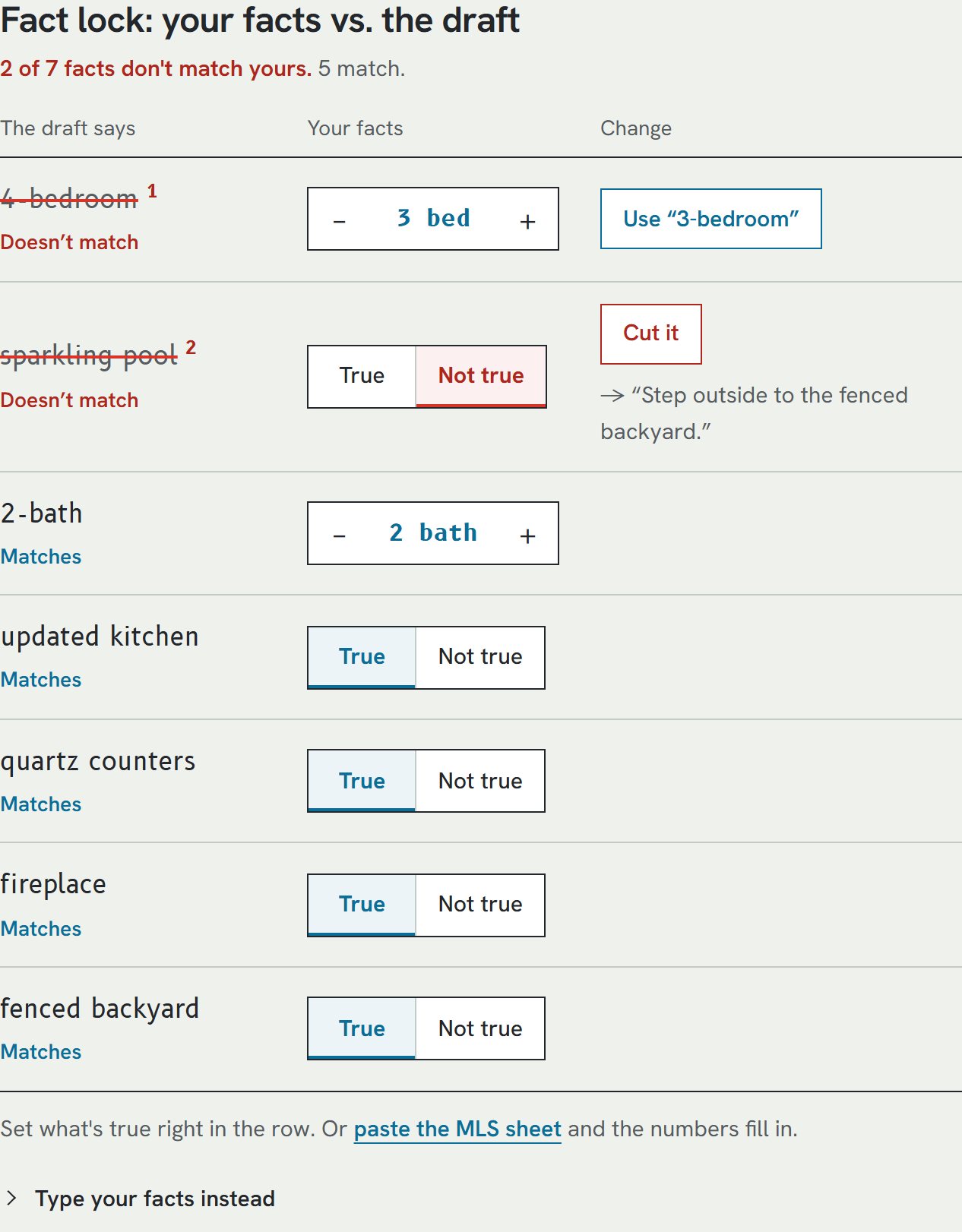
AI writers sometimes add features nobody confirmed, like a pool or an extra bedroom. The fact lock turns the draft's own claims into rows right under it. Beds and baths get a stepper and each feature gets True or Not true, so there's no form to fill in first. If you have the MLS sheet handy, paste it and the numbers fill themselves in.
| The draft says | Your facts | ListingLint |
|---|---|---|
| 4-bedroom | 3 bed | Use "3-bedroom" |
| sparkling pool | no pool | Cut it: "Step outside to the fenced backyard." |
| renovated kitchen | not set yet | True? Keep it. Not true? Cut "renovated". |
"Cut it" removes the claim and keeps the sentence grammatical, and Undo brings it back. Because it's rules, it can't hallucinate. Rewrites only change wording, never facts.
Written rules, each with a source.
ListingLint has 124 rules, 106 that flag and 18 that explain acceptable terms, and every one cites a source. There's no AI model in it, so it can't make anything up. It covers the seven federal protected classes plus the common state and local additions:
- Race & color
- National origin
- Religion
- Sex, incl. sexual orientation & gender identity*
- Disability
- Familial status
- Source of income, age, marital & military status (state/local)
- Steering code words
*Covered by NAR's Code of Ethics (Standard of Practice 10-3) and many state laws. HUD withdrew its 2021 memo on this in Sept. 2025.
- FHAFair Housing Act, 42 U.S.C. § 3604(c)
- CFRHUD advertising regulation, 24 CFR § 100.75
- MEMOHUD advertising guidance memo, Jan. 9, 1995
- LIBORLong Island Board of REALTORS® word and phrase guidelines, Mar. 2025
- CRMLSCRMLS Fair Housing Word & Phrase List
- NYPANew York Press Association word and phrase list
HUD's April 2024 guidance on advertising through digital platforms was withdrawn on Sept. 17, 2025. The Fair Housing Act and 24 CFR 100.75 didn't change, and neither did the rules built on them.
Per HUD's 1995 memo, "master bedroom", "family room", "mother-in-law suite", "walk-in closets" and "wheelchair ramp" don't violate the Act. ListingLint leaves them alone and tells you why, so nobody strips harmless words out of nervousness. If your MLS prefers "primary bedroom", it offers that swap as house style.
When the lists disagree, it shows both. The CRMLS and NYPA lists accept "great for family", and the Long Island REALTORS® list prohibits it.
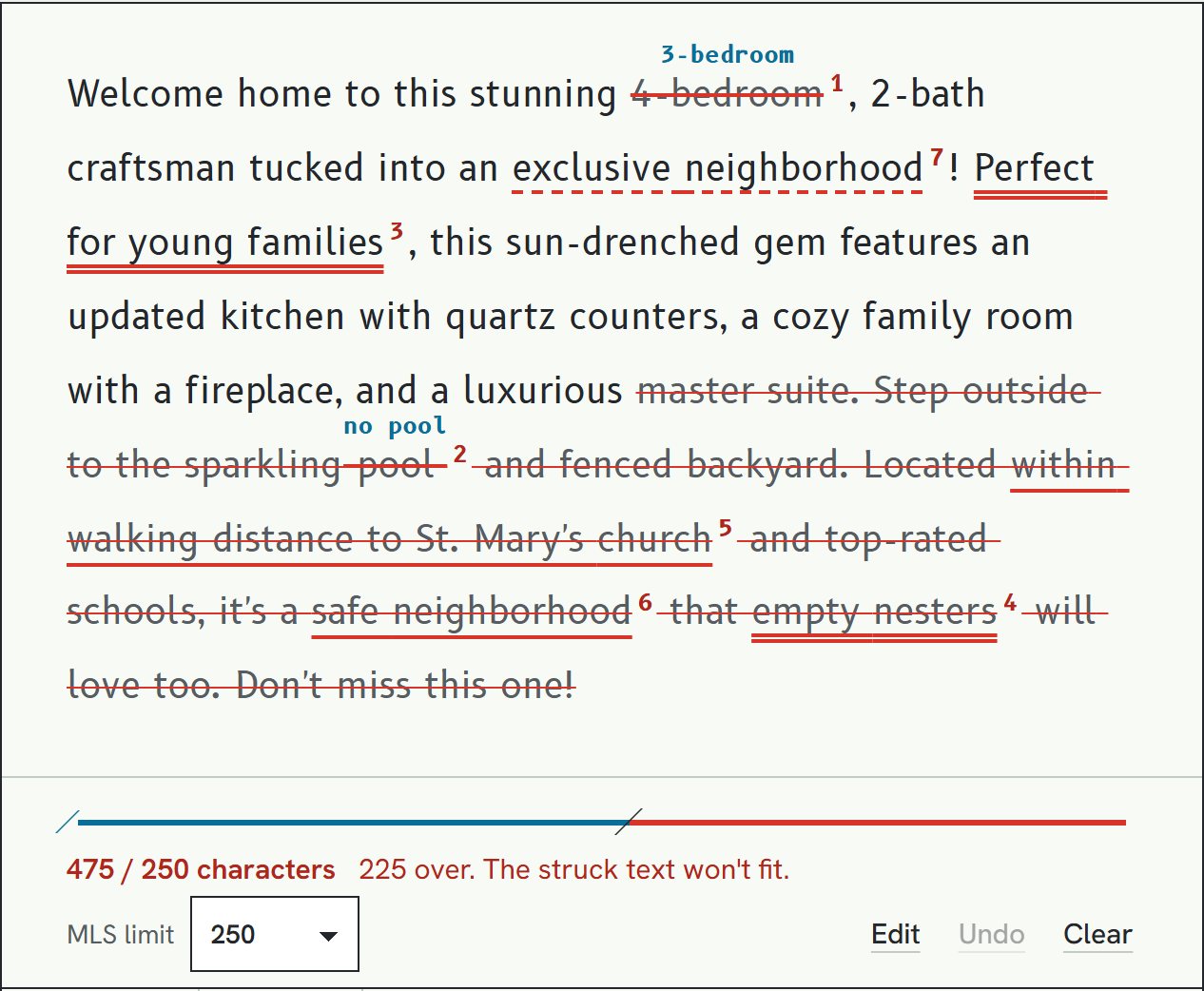
MLS remarks have hard limits, and AI copy runs long. The dimension line under the draft measures it against 250, 500, 1,000 or 4,000 characters, or your own limit. It all runs in your browser. Your listing text isn't sent anywhere, there's no account, and no AI model reads it.
The checker is free. Pro is $29, once.
No monthly subscription. It checks copy from whatever writing tool you already use.
| Free checker$0 · no account | ListingLint Pro$29 one-time |
|---|---|
| Every rule, every flag, every safer rewrite | Offline single-file version: one HTML file that runs with no internet. Keep it on your laptop or the office drive. |
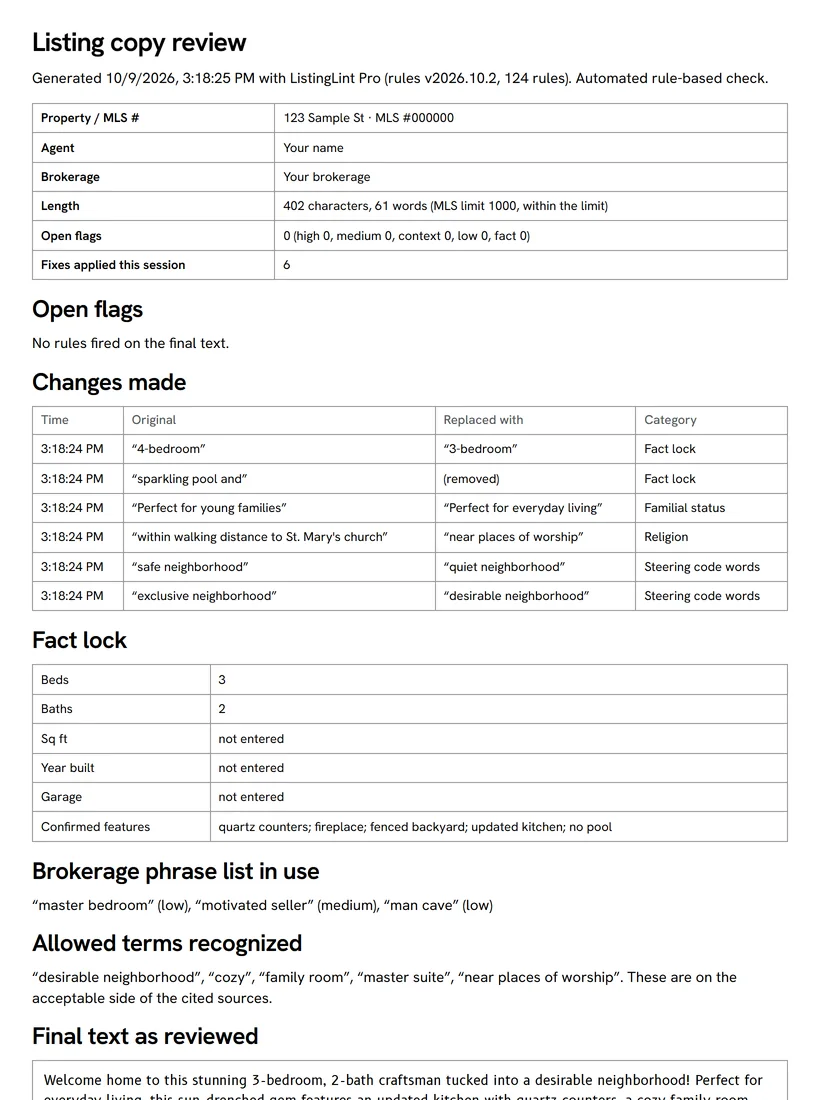
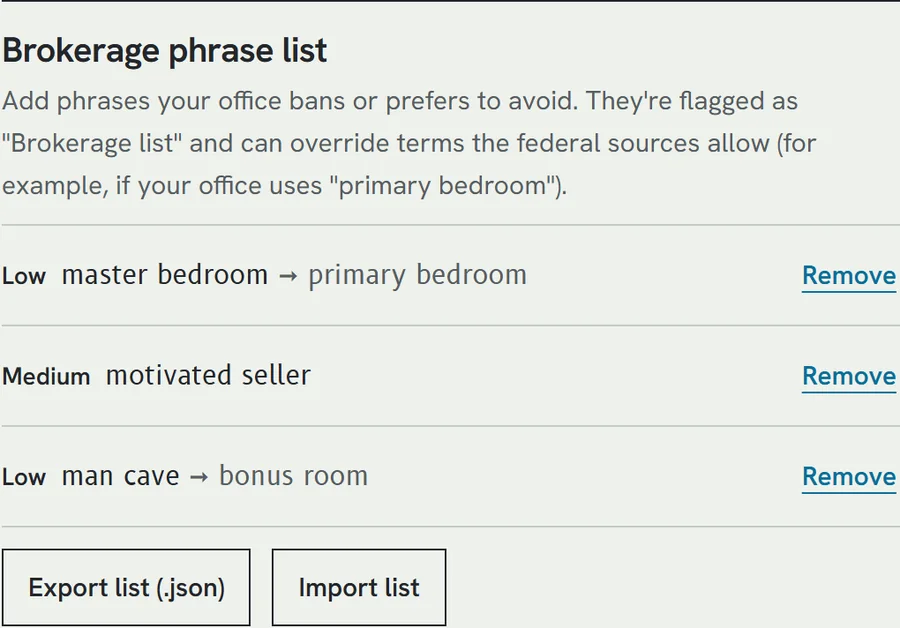
| Fact lock for beds, baths, sq ft, year built, garage and features, plus "paste the MLS sheet" | Brokerage phrase list: your office's banned or preferred phrases with your own replacements, then import or export the list for your team. |
| MLS character count and Copy for MLS | PDF review record: the flags, the fixes you applied, your facts and the final text with sign-off lines, for your file or your broker. |
| No account, email or daily limit | Everything in the free checker |
| Open the checker | Get Pro for $29
You download it right after checkout. 14-day refund if it's not for you. Pro checkout isn't open yet. The free checker works fully today. |
Pro won't flag anything the free checker misses. Both run the same rules and offer the same rewrites. Pro is for working offline and keeping a record.
- Pay on Stripe's checkout page. Stripe handles the card. We never see the number.
- You land on your download page. One file, listinglint-pro.html, about 500 KB. Save it and double-click it on your laptop or office computer.
- Run one listing through it. The file opens with three steps: paste, lock the facts, print the record. About 3 minutes.
If Pro isn't for you, email us within 14 days and you get the full $29 back. ListingLint is made by FantasyLab, and the person who built it answers the support email. The download page remembers your order on the computer you bought on for 30 days.
What it won't do
- It's not legal advice, and a clean result doesn't make an ad compliant.
- It's a word and phrase check. It can't see photos, ad targeting, or meaning that depends on the whole ad.
- It covers the federal classes plus common state and local additions (source of income, age, marital and military status), not every state and city rule.
- English only.
- Suggested rewrites only change wording, and some flags have no one-click fix.
Read the final copy once, the way a buyer would.
I made ListingLint. The checker is free; Pro is $29 one-time.
Questions agents ask.
Is this legal advice?
No. ListingLint is a word check built on written rules from HUD guidance, the federal advertising regulation and published REALTOR®/MLS word lists. It can't judge every context, and state and local laws add protected classes. A clean result doesn't make an ad compliant. When in doubt, ask your broker or a fair housing attorney.
Does it use AI?
No. Every flag comes from a written rule with a cited source, so it can't hallucinate or invent a claim about the property. Rewrites change wording, never facts.
Do I have to stop saying "master bedroom"?
No. HUD's 1995 memo says "master bedroom" doesn't violate the Act, and the CRMLS and NYPA lists accept it. Some MLSs and brokerages prefer "primary bedroom". That's house style, so ListingLint offers the swap without flagging the original.
How does "paste the MLS sheet" work?
Paste the listing's MLS printout or data page. It reads labeled fields only (Beds, Full Baths, SqFt, Year Built, Garage Spaces, Pool: None, Interior Features). It skips the remarks, so the draft can never vouch for itself, and it skips anything that could mean two things, like "Baths: 2.1". All of it happens in your browser.
What does Pro add?
An offline copy you can keep on the office drive, your brokerage's own phrase list and a printable review record for the listing file. The checking itself is the same as on the free page.
Why flag "walking distance"? It's everywhere.
It's on the caution side of the Long Island REALTORS®, CRMLS and New York Press Association lists because it can read as excluding people who don't walk. It's marked Context, meaning it depends on how it's used. "Convenient to" or an actual distance sidesteps the question. "Walk-in closet" and "walk to the bus stop" aren't flagged.
Will it catch everything?
No. A word list can't see photos, targeting, or meaning that depends on the whole ad. It catches the common phrases and the claims that don't match the facts you set. Someone still has to read the final copy.
Do the sources ever disagree?
Yes. "Great for families" is acceptable on the CRMLS and NYPA lists and prohibited on Long Island's. Where sources split, the flag says so and shows both instead of pretending there's one answer.
What if Pro isn't for me?
Email us within 14 days of purchase for a full refund: .
How do I get Pro after I pay?
Checkout is a Stripe page, and we never see your card. When it's done you land on a download page for the single-file offline version. That page remembers your order on the same computer for 30 days and has an "Email me this link" button. If you lose it after that, email us from the address you paid with and we'll send the file again.
Does Pro work on a phone?
It's made for a laptop or desktop, where you can save the file and double-click it. The free checker on this site works on a phone, with the same rules.
Where does my text go?
Nowhere. The checker runs in your browser, and your draft and facts are saved only in this browser (localStorage) so a refresh doesn't lose them. Clear them any time.
Get rule updates
Word lists and guidance change. Leave an email and we'll tell you when the rules are updated, and that's all we send.